Ziaja Goat’s Milk Night Cream Review: Worth It?
Ziaja: Dry skin that feels tight at 6 a.m. is a specific kind of annoying. You moisturize before bed, and by morning your cheeks feel like paper again.
That overnight moisture leak is the exact problem this Polish drugstore jar claims to fix. It has been around for decades and still sells fast every winter.
I used it nightly for four weeks through a cold, dry stretch. Here is what held up and what did not.
Disclaimer: I am not a dermatologist. This is my own experience plus what I found in the ingredient data and real user feedback. Always patch test.
In a Nutshell:
- Best for dry, dehydrated, and mature skin. Ziaja itself lists this for age 20+ with dry, mature, or wrinkle-prone skin. That targeting is accurate, not marketing fluff.
- The formula is simple and emollient-led. Glycerin sits third on the list, backed by cetearyl ethylhexanoate, hydrogenated coco-glycerides, and beeswax. It seals moisture in rather than delivering actives.
- The goat milk angle is real but modest. Goat milk extract and a Lactobacillus milk ferment appear low on the list. Expect comfort and softness, not collagen rebuilding.
- Fragrance is the biggest dealbreaker. The formula contains parfum plus several declared allergens including citronellol, geraniol, eugenol, and limonene. Sensitive and reactive skin should skip it.
- Value is genuinely excellent. A 50 ml jar usually costs under fifteen dollars and lasts two to three months at nightly use.
- It is not a treatment cream. No retinol, no peptides, no niacinamide. Buy it as a barrier layer, not as an anti-aging step.
The Problem This Cream Actually Solves
Most cheap night creams fail at one job: staying put. They absorb, feel nice for an hour, then vanish.
This one is built differently. It is a heavy occlusive layer with humectants underneath, which is the classic formula for overnight transepidermal water loss.
If your skin flakes around the nose, feels tight after cleansing, or looks dull by morning, that is the concern this addresses.
It will not fade dark spots. It will not smooth deep lines. Ziaja’s own copy mentions smoothing minor wrinkles, and I would read that as plumping from hydration rather than structural change.
What it does well is stop the leak. My skin stayed comfortable through the night instead of waking up parched.
That is a narrow benefit, but it is the benefit most dry-skinned people are actually shopping for. I would rather a product do one thing properly than promise six things vaguely.
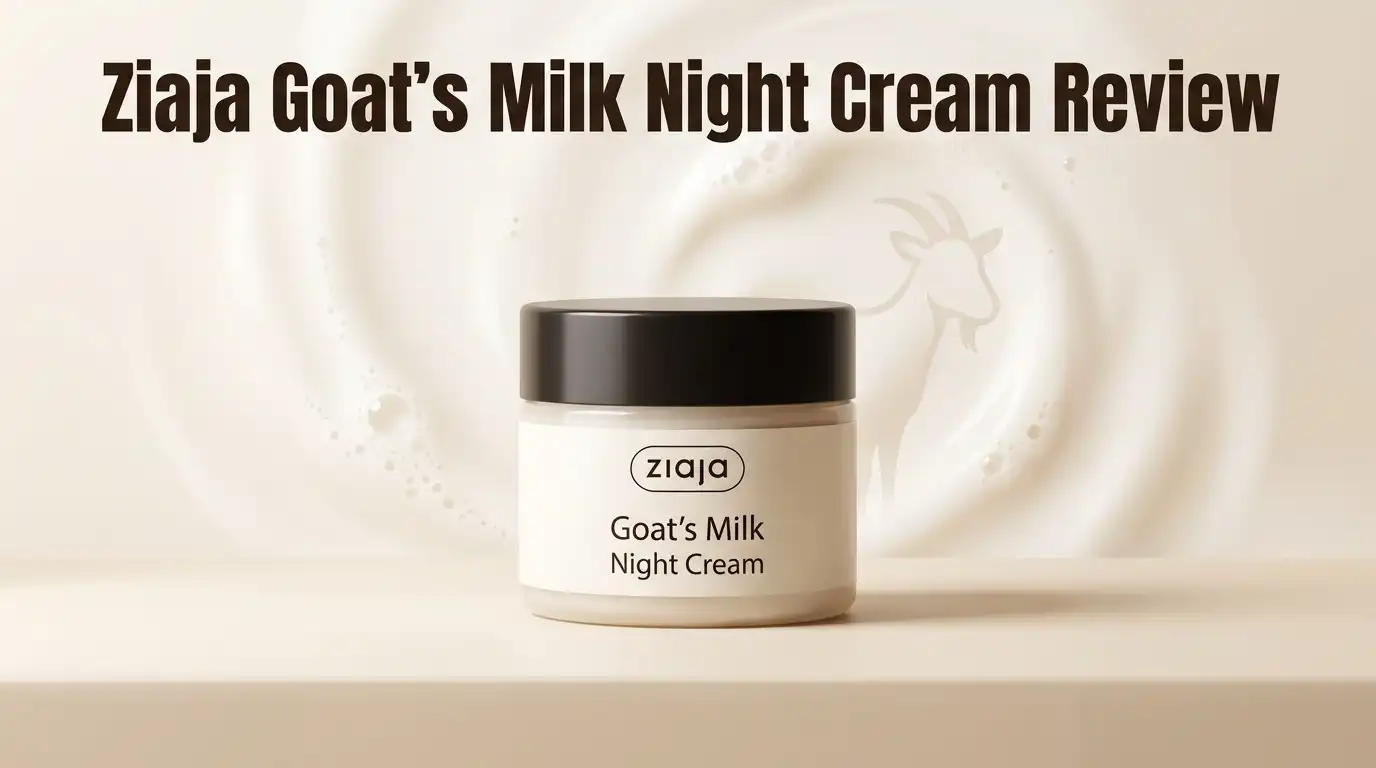
Ziaja Goat’s Milk Night Cream

- Goat's Milk Night Cream
- Product Size: 1.7 fl oz (50 ml)
Last update on 2026-08-01 / Affiliate links / Images from Amazon Product Advertising API Some of the links on this website are affiliate links, which means that at no additional cost to you, I earn a commission if you click through and make a purchase. I only recommend products and services that I believe will add value to my readers. Thank you for your support!
The jar is 50 ml of white, dense cream. Ziaja is a family-run Polish pharmacy brand from Gdańsk, and the packaging reflects that unfussy origin.
The current European formulation states 95% ingredients of natural origin and is free from GMOs, gluten, mineral oils, SLES, parabens, silicones, and microplastics.
That claim list is more meaningful than usual because the formula is short. There are fewer than twenty functional ingredients before you reach the fragrance components.
Ziaja markets it alongside a matching day cream and eye cream. You do not need the full set, though the day version is lighter if you want continuity.
One important detail: formulations differ by region. The 2024 European ingredient list dropped retinyl palmitate and the preservative 2-bromo-2-nitropropane-1,3-diol. Some stock sold in the United States still lists both.
Check the box you receive. It matters if you are avoiding retinoids or specific preservatives.
Top 3 Alternatives for Ziaja Goat’s Milk Night Cream

- Goat's Milk Day Cream
- Key Ingredients: Vitamin E, Vitamin A, Provitamin B5 (d-panthenol), Goat's Milk Complex
Last update on 2026-08-01 / Affiliate links / Images from Amazon Product Advertising API Some of the links on this website are affiliate links, which means that at no additional cost to you, I earn a commission if you click through and make a purchase. I only recommend products and services that I believe will add value to my readers. Thank you for your support!
Ziaja Goat’s Milk Day Cream

- [ PEPTIDE COMPLEX ] Help reduced the look of fine lines and wrinkles while supporting skin elasticity
- [ OVERNIGHT MOISTURIZER ] Helps soften, hydrate and retain skin's moisture with hyaluronic acid. Renew the look of tired skin overnight. This skin care product does not come with a protection inner seal.

Last update on 2026-06-09 / Affiliate links / Images from Amazon Product Advertising API Some of the links on this website are affiliate links, which means that at no additional cost to you, I earn a commission if you click through and make a purchase. I only recommend products and services that I believe will add value to my readers. Thank you for your support!
CeraVe Skin Renewing Night Cream

- HELPS IN 5 WEEKS: This Eucerin moisturizer helps to reduce the look of fine lines and wrinkles in as little as 5 weeks (after twice daily usage)
- FREE OF: Eucerin Q10 face cream for wrinkles is fragrance, alcohol and dye free, and can be used alone or under make-up
Last update on 2026-08-01 / Affiliate links / Images from Amazon Product Advertising API Some of the links on this website are affiliate links, which means that at no additional cost to you, I earn a commission if you click through and make a purchase. I only recommend products and services that I believe will add value to my readers. Thank you for your support!
Eucerin Q10 Anti-Wrinkle Face Cream
The Unboxing and Packaging Reality
There is no unboxing moment here, and I mean that literally. A thin cardboard carton, a plastic jar, a foil seal, done.
The jar feels light and slightly hollow. The lid screws on with about a half turn and does not click, so it can loosen in a travel bag.
No spatula is included. You dip fingers in, which introduces bacteria over time and is the standard argument against jar packaging.
I decant a week’s worth into a small pot if I am traveling. For home use I just wash my hands first and stop worrying about it.
The 50 ml size looks small next to the price tag, but it is deceptive. The cream is dense enough that a pea-sized amount covers a full face and neck.
Print on the jar is tiny. If you need to read the batch code or period-after-opening symbol, you will want good light.
Functional, cheap, honest. Nobody is buying this for the shelf appeal.
What Is Actually Inside the Jar
The list opens with water, then cetearyl ethylhexanoate, a lightweight synthetic emollient that absorbs without greasiness. Third is glycerin, the workhorse humectant that pulls water into the upper skin layers.
Then come the texture builders: diisostearoyl polyglyceryl-3 dimer dilinoleate, hydrogenated coco-glycerides, and later cera alba (beeswax) and hydrogenated castor oil.
Tocopheryl acetate provides antioxidant support, though the esterified form absorbs less efficiently than pure vitamin E.
Propylene glycol appears as a secondary humectant and solvent. It is well tolerated by most people despite its internet reputation.
The interesting pair sits mid-list: a Lactobacillus/milk solids/soybean oil ferment and goat milk extract. Ferments supply lactic acid derivatives, amino acids, and lipids that support the barrier.
Beeswax means this is not vegan. Worth flagging, since plenty of shoppers assume drugstore creams are.
Preservation comes from sodium benzoate, sometimes paired with bronopol in older stock. The whole thing is alcohol-free, which helps with dryness.
The Goat Milk Complex Claim, Honestly Assessed
Ziaja says its goat’s milk complex stimulates collagen and elastin synthesis and delays the aging process. That is the manufacturer’s language, and I want to translate it.
Goat milk contains lactic acid, fatty acids, and vitamins. Those are legitimately good for dry and compromised skin.
But the extract sits tenth on the ingredient list, well after the emulsifiers. The concentration is almost certainly low.
There are no published clinical trials on this specific product. No percentage disclosures, no third-party testing data, no before-and-after imaging I could verify.
So here is my honest read: the goat milk is a pleasant supporting ingredient, not the engine. The emollients and glycerin are doing the heavy lifting.
That does not make the cream bad. It makes the marketing generous.
If you want measurable collagen support, you need a retinoid or a peptide formula. If you want your skin to stop feeling like sandpaper by Thursday, this works.
Buy it for what it is.
Texture, Scent, and How It Absorbs
The cream is thick and slightly waxy at room temperature. Scooping it out takes a bit of pressure with a cold jar.
It warms up fast between the fingers and spreads further than expected. My first mistake was using far too much.
Absorption takes roughly five to eight minutes. During that window your face looks shiny and feels tacky, which is why this is a night product.
Once settled, it leaves a soft, cushioned finish rather than a greasy film. My pillowcase did not show transfer.
The scent is the polarizing part. It is a sweet, powdery, almost soapy floral that reads as classic European pharmacy cream.
Some people love it. On Reddit, one user said the smell was their favorite thing about the line, while another called it way too much fragrance and stopped using it.
I found it strong on application and faint within twenty minutes. If perfumed skincare bothers you, this will bother you.
My Four Week Test on Dry Winter Skin
Week one, I applied too much and woke up feeling slick. Cutting back to a pea-sized amount fixed that immediately.
By day five, the flaking around my nose and the outer edges of my eyebrows had stopped. That was the fastest visible change.
Week two brought the improvement I cared about most. Morning tightness disappeared. My skin felt supple when I woke instead of stretched.
Makeup application improved slightly by week three, mostly because there was no dry texture for foundation to catch on.
Fine lines under my eyes looked softer, but I attribute that to hydration plumping rather than any structural effect. They returned to baseline on nights I skipped.
Week four, no breakouts, no irritation, no clogged pores on my cheeks. My chin, which is oilier, felt slightly congested twice.
Verdict after a month: reliable comfort, zero drama, no transformation. For the price, that is a fair trade.
Who Should Skip This Cream
I want to be direct, because this cream genuinely does not suit everyone.
Sensitive, rosacea-prone, or eczema-prone skin should avoid it. The fragrance load includes citronellol, geraniol, eugenol, limonene, and linalool, all declared EU allergens. Oxidized limonene and linalool are recognized skin sensitizers.
One Reddit user with rosacea reported the cream aggravated their flushing even though it did not break them out.
Oily and acne-prone skin will likely find it too heavy. Several users described it as better suited to the body than the face.
Anyone with a milk protein allergy should patch test carefully or skip it entirely. This is a real caution, not a theoretical one.
If your stock contains retinyl palmitate, avoid it during pregnancy without checking with your doctor first.
Fragrance-free devotees, vegans, and people who dislike jar packaging also have better options elsewhere.
Everyone else with dry, normal-to-dry, or mature skin is a good candidate.
Pros and Cons at a Glance
Here is the balanced breakdown after four weeks of nightly use.
Pros:
- Excellent overnight moisture retention for dry and dehydrated skin, with no morning tightness after the first week.
- Very affordable, usually under fifteen dollars for 50 ml, and it lasts two to three months.
- Short, readable ingredient list with glycerin high up and no alcohol, silicones, parabens, or mineral oil.
- Rich enough to double as a barrier balm on cheeks, elbows, or dry patches during cold months.
- Soft, cushioned finish that does not transfer heavily onto bedding.
- Widely available and consistently rated around 4.4 stars across large retailer review pools.
Cons:
- Heavy fragrance load with multiple declared allergens makes it unsuitable for reactive skin.
- No proven actives. Zero niacinamide, peptides, or effective retinoids.
- Jar packaging with no spatula, plus a lid that loosens easily.
- Contains beeswax, so it is not vegan.
- Formulation varies by region, which makes ingredient checking necessary.
- Too occlusive for oily or acne-prone faces, especially in humid weather.
- Marketing claims about collagen and elastin lack published supporting data.
How to Use It for Best Results
Less is genuinely more. Start with a pea-sized amount for your whole face and add only if needed.
Apply to slightly damp skin. The glycerin needs water to grab onto, and damp application improved my results noticeably.
Ziaja recommends patting rather than rubbing. Warm the cream between your fingertips first, then press it in.
Layer it last. It goes on top of serums, essences, and any hydrating toner, since nothing penetrates through this level of occlusion.
Wait five minutes before your pillow touches your face. Rushing this is how you lose half the product to your bedding.
Do not layer it over a prescription retinoid on the same night without checking tolerance, especially if your jar contains retinyl palmitate.
In humid summer months, consider using it only on dry zones rather than all over. I switch to something lighter from June through August.
Patch test behind the ear for two nights before committing.
Price, Value, and Where It Fits
At typically eight to fourteen dollars for 50 ml, this is one of the cheapest functional night creams available in Western markets.
Cost per night works out to roughly fifteen cents. That is difficult to argue with.
Compared to CeraVe’s Skin Renewing Night Cream, Ziaja is cheaper but has no peptides or niacinamide. CeraVe is the smarter pick if you want actives.
Compared to Nivea Creme, Ziaja absorbs faster and feels less suffocating on the face.
Compared to Aestura or Dr. Althea barrier creams, Ziaja is a fraction of the price and roughly two-thirds as effective. Fine for most people.
Where it fits best: as the sealing step in a simple dry-skin routine, or as a winter-only upgrade over a lighter daily moisturizer.
I would not build a routine around it. I would keep a jar in the cabinet from October through March, and I plan to.
Frequently Asked Questions
Is Ziaja Goat’s Milk Night Cream good for acne-prone skin?
Generally no. The formula is occlusive and fragranced, which is a poor combination for congestion-prone skin. Some users report no breakouts, but the risk is higher than with a gel-cream. Try it on dry patches only if you want to test tolerance.
Does it contain retinol?
Not in the current European formulation. Older stock and some United States listings include retinyl palmitate, the weakest retinoid ester, which most research considers topically ineffective. Read your specific jar’s ingredient panel.
Can I use it during pregnancy?
Check the label. If retinyl palmitate is listed, most doctors advise avoiding it. If your jar follows the newer retinoid-free formula, the remaining concern is the fragrance. Ask your obstetrician rather than relying on a blog post.
Is it suitable for vegans?
No. The formula contains cera alba (beeswax) alongside goat milk derivatives.
How long does one jar last?
At a pea-sized nightly amount, expect two to three months. Heavier application cuts that to about six weeks.
Will it work under makeup during the day?
It can, on very dry skin in cold weather. Give it fifteen minutes to settle first. On combination or oily skin it will cause slipping.
Is the fragrance overwhelming?
It is noticeable and sweet on application, then fades within twenty minutes. Feedback splits sharply between people who love it and people who find it excessive.
Does it help with wrinkles?
It softens the look of fine lines through hydration. It will not change deeper wrinkles, and there is no clinical data supporting the collagen claims.

Hi there! I’m Cressida June, the voice behind Echo Insights, where I dive deep into the world of Amazon products to bring you honest, comprehensive reviews across multiple categories.
As a passionate product researcher and reviewer, I believe that every purchase deserves careful consideration. Whether you’re searching for the perfect kitchen gadget, the latest tech innovation, home essentials, or lifestyle products, I’m here to cut through the noise and deliver the insights you need to make informed decisions.